A 60% humidity reading inside a Venice, FL home is not just a statistic. It is the beginning of a structural disaster. Most seasonal residents believe that as long as the temperature is set to a reasonable level, their property is protected. They are wrong.
In Southwest Florida, humidity is a relentless force that works 24 hours a day to find a way into your living space. What many homeowners underestimate is how quickly a minor mechanical oversight transforms into a five-figure remediation bill. We see this regularly. A homeowner leaves for the summer, sets the thermostat to 78 degrees, and returns to find their leather furniture covered in a fine white dust. Except it isn't dust.
The margin for error in a tropical climate is razor-thin. Without professional oversight, a home can cross the threshold from "safe" to "infested" in less than a week.
1. The Financial Trap of Turning the AC Off Entirely
The most common mistake involves the "OFF" switch. Some owners believe that if the home is empty, there is no reason to run the air conditioner. They assume the heat won't hurt the drywall or the cabinets.
They forget that in Venice, the AC unit is actually a giant dehumidifier. Its primary job is not just to cool the air, but to wring moisture out of it. When the system stays off, the indoor humidity quickly matches the outdoor levels, which frequently hover between 80% and 90%.
By the time the indoor relative humidity hits 65%, mold spores begin to colonize porous surfaces. What starts as a $100 monthly savings on the electric bill often results in a $15,000 mold remediation claim. The damage extends to electronics, clothing, and even the structural studs behind your walls.
2. Setting the Humidistat and Walking Away
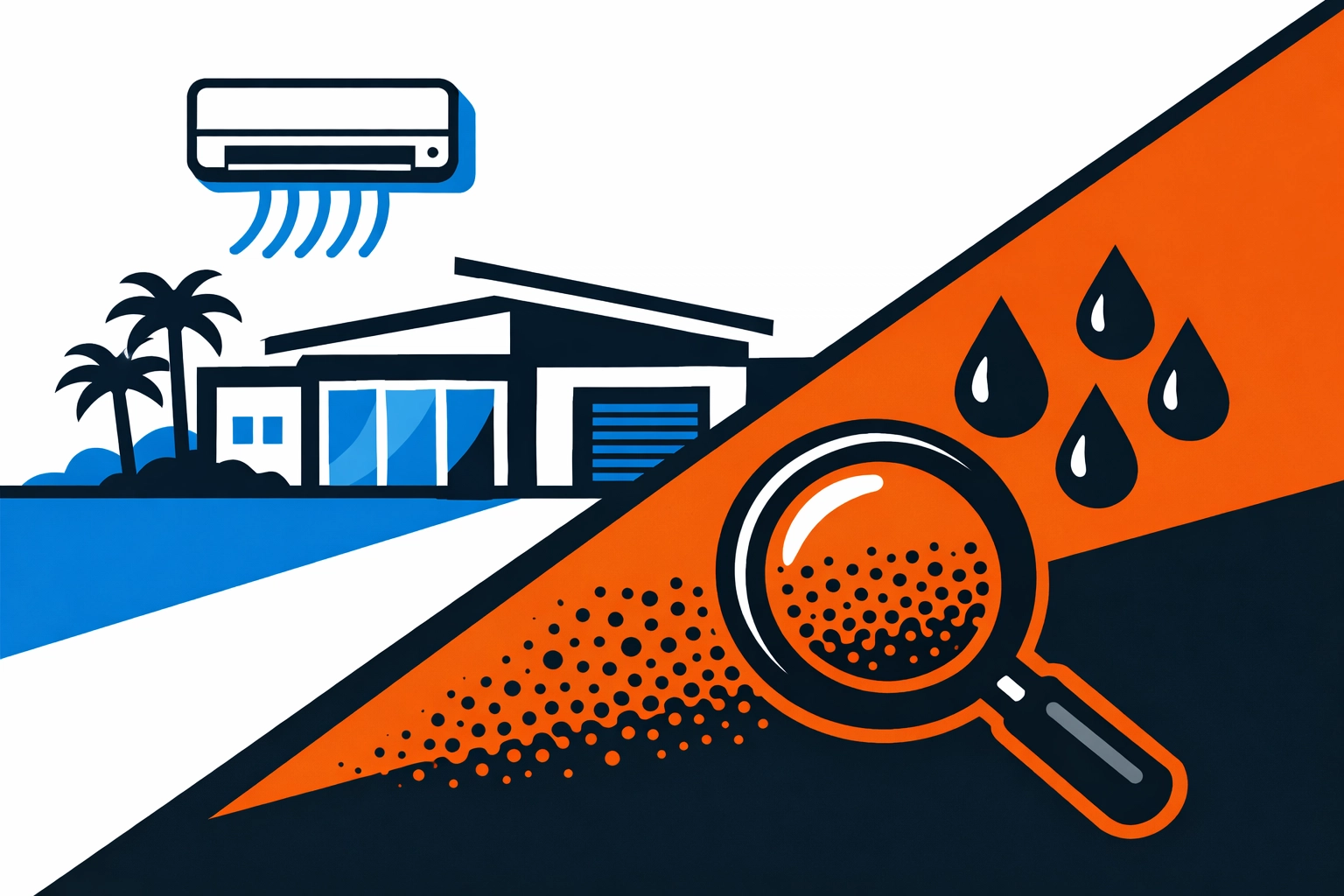
Many homes in North Port and Wellen Park are equipped with a humidistat. This device is designed to turn the AC on only when the humidity rises above a certain point. It is a valuable tool, but it is frequently misused.
Homeowners often set the humidistat too high, thinking 65% is safe. In reality, sensors drift over time. A dial set to 60% might actually be allowing the home to reach 68%. Furthermore, if the humidistat is located in a drafty hallway or near a bathroom, it provides an inaccurate reading of the rest of the home.
Without regular calibration and physical checks by a home watch company Venice FL, you are essentially trusting a $20 piece of plastic to guard your most valuable asset. If that device fails, the system stays off while the moisture accumulates unnoticed.
3. Ignoring the Condensate Drain Line
The most frequent mechanical failure we encounter is a clogged condensate drain line. As your AC pulls water out of the air, that water must go somewhere. It flows into a plastic pipe that leads outside.
Because Florida's water is warm and full of nutrients, algae and "slime" grow inside these lines with incredible speed. Eventually, the line blocks. When this happens, the water has two choices: trigger a safety float switch to shut the system down, or overflow into your house.
If the safety switch works, your AC turns off. In the middle of a July heatwave, your indoor humidity will skyrocket within 48 hours. If the switch fails, the water leaks into your ceiling or onto your floor. We have seen instances where a blocked line caused thousands of dollars in water damage before the humidity even became the primary concern. Regular flushing of these lines is a core part of our services.
4. The Hidden Risk of an Oversized HVAC System
It sounds counterintuitive, but a "bigger" air conditioner is often worse for humidity control. This is a technical detail many homeowners miss during a replacement.
If an HVAC unit is too large for the square footage of the home, it reaches the target temperature too quickly. This is known as short-cycling. The system turns on, blasts the house with cold air for five minutes, and shuts off.
The problem is that it takes at least 10 to 15 minutes of continuous run time for the evaporator coils to get cold enough to effectively remove moisture. An oversized system creates a home that is cold but "clammy." This high-moisture environment is a breeding ground for biological growth. When we perform a home watch Florida inspection, we look for these specific cycles that indicate the system isn't doing its job.
5. Relying Solely on Ceiling and Exhaust Fans
Some owners assume that leaving ceiling fans running will prevent mold. This is a myth. Fans move air; they do not remove water. While air movement can slightly inhibit mold growth on a surface, it does nothing to lower the overall humidity of the room.
In fact, leaving fans running while a home is vacant is a fire risk and a waste of electricity. Worse yet, some homeowners leave bathroom exhaust fans running 24/7. These fans are designed to pull air out of the house.
When you pull air out, you create a vacuum. That vacuum must be filled. In Southwest Florida, that "replacement" air is pulled in through every crack in your windows, doors, and attic. You are essentially sucking the humid, 90-degree Florida air directly into your home. It is a recipe for disaster.
6. The "Neighbor Check" Security Gap
The "neighbor check" is one of the most dangerous alternatives to professional management. A well-meaning neighbor might walk into your home and think it "feels" fine. However, humans are notoriously poor at detecting a 5% shift in relative humidity.
By the time a human can smell the mustiness of mold, the infestation is already advanced. Neighbors typically don't check the humidistat calibration, they don't inspect the condensate pan for standing water, and they don't use digital hygrometers to verify the HVAC performance.
Professional home watch services use objective data. We don't guess how it feels; we measure what is happening. If you want to know more about the difference, our FAQs explain the specific protocols we follow.
7. Lack of Smart Monitoring and Data
We live in an era where technology can provide an early warning system. One of the biggest mistakes is failing to integrate smart home technology into your moisture defense strategy.
Wi-Fi-enabled thermostats and leak detectors can alert you the moment your system fails. However, an alert is only useful if someone is available to respond. We have seen homeowners receive a "High Humidity" alert while they are 1,000 miles away, only to find that no HVAC company can get to their house for three days.
Having a local professional who is already familiar with your property means that when that alert hits, the solution is already in motion. It is the difference between a minor inconvenience and a total loss.
The Surprise Most Homeowners Don't Anticipate Regarding Insurance
One of the most painful aspects of humidity damage is the insurance reality check. Most homeowners' insurance policies in Florida have very specific language regarding mold.
In nearly every case we encounter, mold coverage is capped at a relatively low amount: often $10,000 or less. Furthermore, many policies require that the homeowner "maintain the property" and "take reasonable steps to prevent damage."
If an insurance adjuster finds that the AC was turned off or that the home was left unmonitored for months, they may deny the claim entirely. They view an unmonitored home as a neglected home. This is why our documentation is so vital. We provide the proof of "reasonable care" that insurance companies demand.
Protecting Your Investment Year-Round
The damage caused by humidity is quiet, invisible, and compounds every hour that it goes unaddressed. What begins as a small clog in a drain line escalates into a saturated floor, which spreads into the drywall, which eventually leads to a complete gutting of the interior.
At Paradise Lifestyle Home Watch, we see the aftermath of these mistakes every season. Our goal is to ensure you never have to experience them. A professional eye and a consistent schedule are the only true defenses against the Florida climate.
Protect your home before the humidity takes hold. Reach out today to learn how our referral program and professional inspections can provide the security your property deserves.
Contact us to secure your peace of mind year-round.